Warm Outbound: Using Signals Without Fake Personalization

Stop wasting time on cold emails that never get opened. Warm outbound is the smarter way to do B2B outreach by focusing on real buyer intent signals like pricing page visits, job changes, and content downloads. The result? Reply rates of 15–25%, compared to the dismal 3.4% from traditional cold emails.
Here’s the deal:
- Why it works: Signals show who’s actively looking for solutions, so you reach out at the right time.
- What to track: Pricing page visits, demo requests, new executive hires, and multi-stakeholder content engagement.
- Tools you need: LinkedIn Sales Navigator for job changes, Bombora for intent data, and RevBoss for automated, personalized outreach.
- How to message: Skip the fake personalization. Address their challenges based on the signals you see.
The first seller to respond to a signal wins the deal 74% of the time. Don’t let your competitors beat you to it.
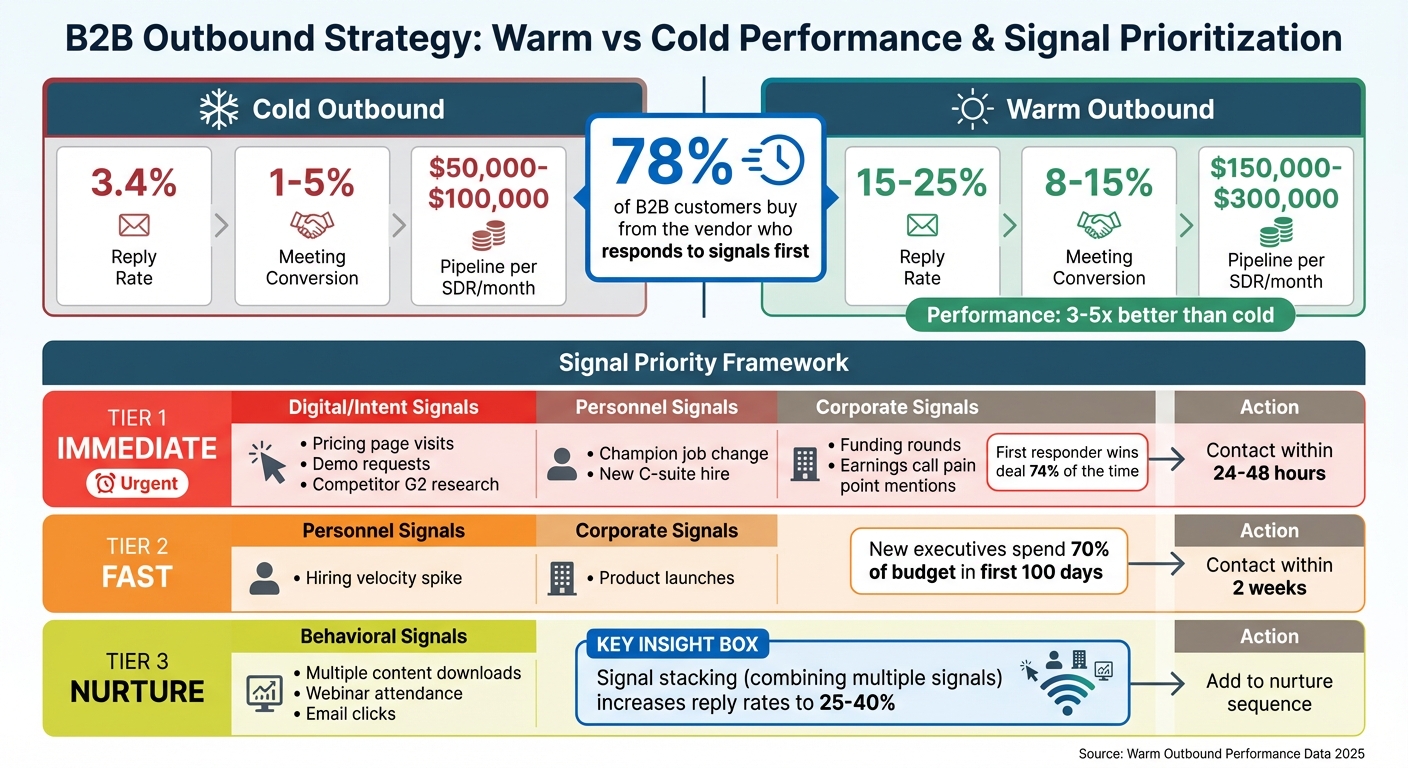
Warm vs Cold Outbound Performance Comparison and Signal Priority Framework
Rethinking Outbound: Why Warmbound Is the Way Forward | OnBase Podcast
sbb-itb-9354cf2
Key Signals for Warm Outbound
Not all signals are created equal when it comes to conversions. The secret to successful warm outbound outreach lies in identifying the right signals and acting on them effectively. This isn't about gathering data just for the sake of it - it's about pinpointing prospects actively seeking solutions. These signals are the backbone of outreach that truly connects in founder-led B2B marketing. Here's what you should pay attention to.
Buyer Intent Signals
When prospects are actively evaluating solutions, they leave behind clear signals. For instance, visiting your pricing page three or more times is a strong indicator they're comparing options and narrowing down their choices. Even stronger signals come from demo requests or free trial signups - these actions show they're ready to engage.
Competitor research is another goldmine. If prospects are browsing review platforms like G2 or Capterra, particularly competitor pages or comparison charts, they're likely building their shortlist. And here's a key stat: 85% of B2B buyers go with a vendor already on their initial shortlist. Tools like Bombora can provide third-party intent data, showing when a company is researching specific industry keywords, giving you a window into their evaluation process.
Speed matters here. Studies show that B2B buyers complete 70% to 80% of their journey before contacting a vendor. Reaching out quickly is critical - leads contacted within five minutes of a signal are 21 times more likely to qualify than those contacted later. Acting fast can mean the difference between driving the conversation or playing catch-up.
But intent signals aren’t the only game in town - changes in professional roles can also open doors.
Job Change and Role Transition Signals
When a former customer or power user moves to a new company, it’s a prime opportunity. These champion job changes convert at 3 to 5 times the rate of cold outreach because trust is already built. They know your product works and often want to replicate that success in their new role.
New executive hires, especially C-suite leaders like CROs, CMOs, or CIOs, are another key signal. These leaders often have a mandate for change and move quickly. In fact, new executives spend 70% of their budget within their first 100 days. The ideal time to reach out is between 3 to 6 months into their tenure, when they’ve identified problem areas, or between 7 to 10 months, when they’re ready to make a big impact before their one-year review.
"In 2025, Cacheflow reported that their sales reps tripled their average deal size within six months by adopting a workflow that triggered outreach based on new hires and news alerts".
On top of intent and role-based signals, behavioral patterns can provide even more clarity.
Behavioral Signals
When prospects are actively researching, their behavior often gives it away. Look for patterns that confirm serious evaluation. For example, if three or more people from the same company engage with your content or visit your site in a short timeframe, it’s a strong sign that a buying committee is forming. This kind of multi-stakeholder engagement is one of the most reliable indicators of intent.
Content consumption also tells a story. A single blog post download might just signal curiosity, but if someone reads three posts on a specific topic, downloads an ROI calculator, and then visits your pricing page, it’s clear they’re in research mode. Companies like Analytic Partners have used account intelligence tools to cut research time from three hours to just 15 minutes per account, leading to a 40% year-over-year increase in qualified pipeline.
Even email forwarding is worth noting. If a prospect shares your email with colleagues, they’re likely building an internal case for your solution. That’s your cue to shift from targeting one person to engaging the broader buying committee.
"Signals help us meet our buyers where they're at."
| Signal Category | High-Intent Examples | Priority Level |
|---|---|---|
| Digital/Intent | Pricing page visits, Demo requests, Competitor G2 research | Tier 1 (Immediate) |
| Personnel | Champion job change, New C-suite hire, Hiring velocity spike | Tier 1/2 (Fast) |
| Corporate | Funding rounds, Earnings call mentions of specific pain points | Tier 1/2 (Fast) |
| Behavioral | Multiple content downloads, Webinar attendance, Email clicks | Tier 2/3 (Nurture) |
The real magic happens when you combine signals. For example, pairing a new VP hire with recent pricing page visits and a funding announcement creates a compelling case for outreach. Acting on isolated triggers isn’t enough - prioritize accounts where multiple signals align.
For example, Frontify adopted a signal-based selling approach and saw a 42% boost in sales velocity and a 400% jump in self-sourced meetings. Their self-sourced revenue grew from 4% to 16% in just three quarters. That’s the power of focusing on the right signals at the right time.
Tools for Signal Detection
Spotting the right signals is only part of the challenge - you need tools that let you act on them in real time. By combining first-party data (like website activity), third-party intent data (market research trends), and contextual signals (such as job changes or funding news), you can create a system that’s both actionable and efficient. Let’s break down the key tools to help you build this setup.
LinkedIn Sales Navigator
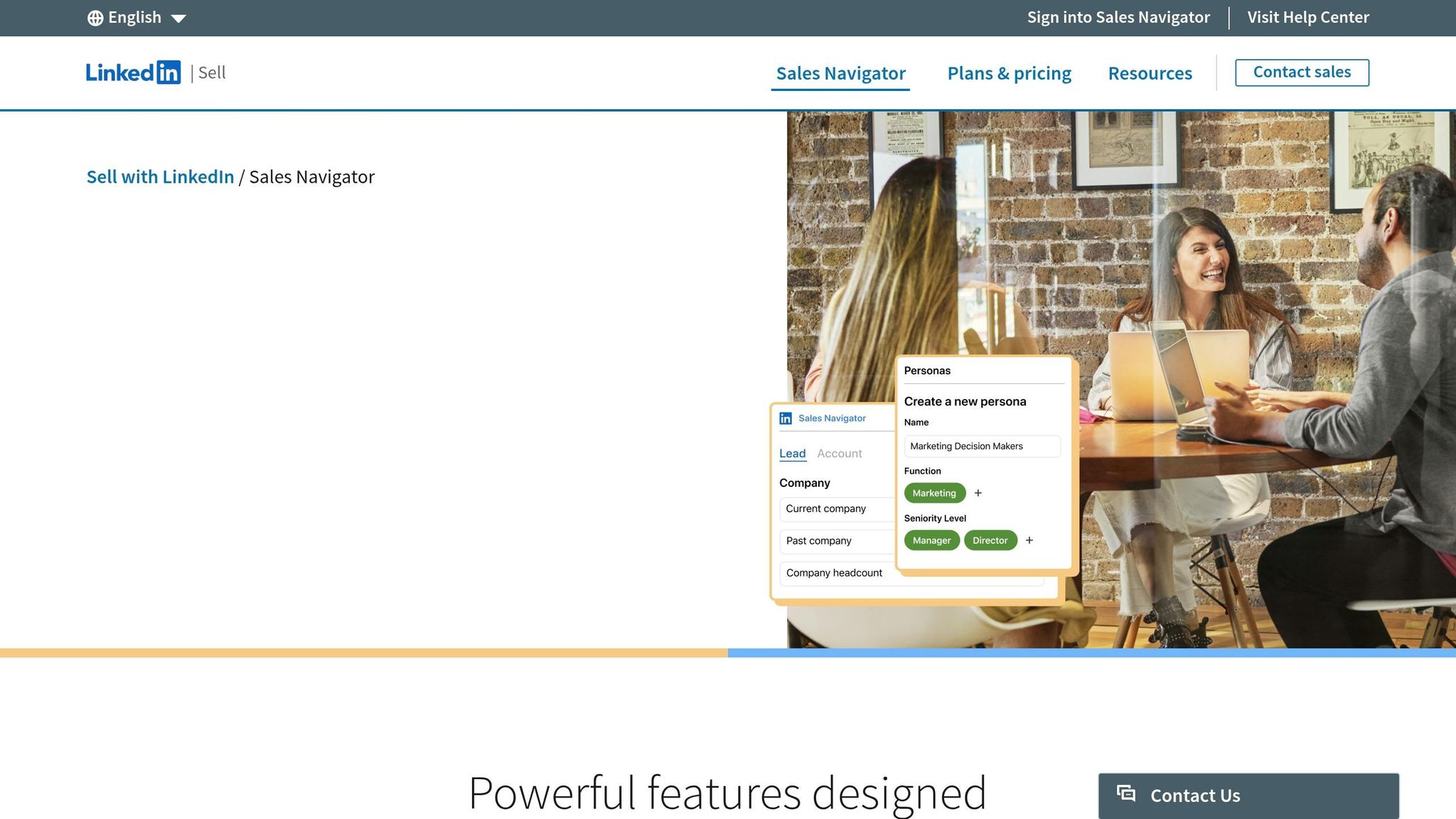
Think of Sales Navigator as your go-to tool for tracking professional shifts and trends in real time. Instead of treating LinkedIn like a static Rolodex, use it to stay updated on dynamic changes like job moves, hiring trends, or content engagement. A smart move? Set up Saved Searches to keep tabs on prospects who’ve changed jobs in the last 90 days or posted content in the past 30 days.
One of the biggest advantages here is speed. Sales Navigator alerts you immediately when a key contact moves to a new company, giving you a golden opportunity to reach out. Research shows that the first seller to engage with a decision-maker after a trigger event is five times more likely to close the deal. However, balance automation with moderation - don’t flood your prospects with excessive connection requests or messages.
While Sales Navigator keeps you informed about professional changes, pairing it with Bombora’s intent data adds another layer of insight.
Bombora for Intent Data
Bombora takes things up a notch by tracking company-level intent through content consumption across a vast B2B publisher network. Covering over 15,000 topics, it identifies when multiple stakeholders at a company are researching specific areas like cloud security or sales automation. This surge in activity signals a prime moment for outreach.
Here’s the catch: Bombora isn’t cheap, with annual costs ranging from $25,000 to $75,000. To make the most of your investment, integrate Bombora with your CRM so your team can act on these signals without missing a beat. When reaching out, reference the general topic rather than making it obvious you’re using search data. Speed is critical - signals lose value quickly, with a 48-hour-old signal being far more actionable than one that’s two weeks old.
"Intent signals don't drive revenue - activated signals do."
RevBoss Audience System
RevBoss complements these tools by focusing on relationship-driven outreach. It captures your team’s expertise and turns it into campaigns tailored to your ideal customer profile (ICP). Instead of just monitoring external data, RevBoss helps you grow LinkedIn audiences, share consistent content, and launch event-driven campaigns triggered by signals. Starting at $1,500 per month, RevBoss delivers content, workflows, and campaigns designed to turn warm signals into meaningful conversations.
The system combines first-party data (like website visits or email engagement) with contextual triggers (such as job changes or funding news) to create multi-layered outreach. For example, if someone in your ICP visits your pricing page multiple times and posts about a new project on LinkedIn, RevBoss can trigger a personalized campaign referencing both behaviors. This approach leads to reply rates of 15%–25%, far exceeding the industry average of 3.4% for cold outreach.
| Signal Category | Tool Example | Key Signal Captured |
|---|---|---|
| First-Party | RevBoss / CRM | Website visits, content downloads, email opens |
| Third-Party | Bombora | Topic research surges |
| Contextual | Sales Navigator | Job changes, hiring spikes, funding |
Writing Signal-Driven Messages
Turn signals into meaningful messages by addressing the business challenges they hint at. Tools like Sales Navigator and Bombora can identify signals, but your messaging should focus on the problems those signals represent. For instance, instead of saying, "I noticed you visited our pricing page", address the likely reason behind it - like scaling their team or evaluating tools.
How to Reference Signals
Every signal points to a bigger business priority. If a company has just hired a VP of Sales, for example, you could reference the typical hurdles new leaders face in their first 90 days, such as ramping up their team or refining processes. Similarly, if they’ve secured new funding, tailor your message to the challenges of managing growth with fresh capital.
Use the SMART Framework to craft your message: Show you understand their challenge, Map your solution to their needs, Acknowledge any gaps, Recognize the potential impact, and Take action. For example, if a company has posted several SDR job openings, highlight how rapid scaling can create productivity bottlenecks and how you can help solve them. This approach can increase reply rates to 15–25%, compared to the dismal 1–5% typical of generic cold emails.
Timing is everything. The first seller to contact a prospect after a trigger event wins the deal 74% of the time. For high-priority signals - like leadership changes, funding announcements, or pricing page visits - reach out within 24–48 hours. Medium-priority signals, such as hiring surges or product launches, give you a slightly longer window of about two weeks before they lose their edge.
"The first seller to reach a prospect after a trigger event wins 74% of the time. Not the best product. Not the lowest price. The first one in the door."
- Craig Elias, Founder, SHiFT Selling
Once you’ve crafted a precise message, the next step is to plan a sequence of well-timed follow-ups.
Building a Multi-Touch Sequence
A 3–5 touch sequence over 14–21 days keeps you on a prospect’s radar. Start with a LinkedIn connection request referencing a warm signal, like a job change or mutual connection. On Day 3, send a personalized email tying the signal to a specific value or insight. Follow up on Day 5 with a phone call and voicemail that builds on your earlier touches. By Day 8, send another email, offering something fresh - like a case study or an industry benchmark related to the signal.
Combining multiple signals - known as signal stacking - can boost reply rates to 25–40%. For example, if a prospect recently visited your website, hired a new executive, and announced a funding round, referencing all three in your outreach can make a stronger impression.
Persistence is key. 93% of conversions happen after six or more follow-ups, but many reps give up after just one or two. Each touchpoint should add value, whether it’s a relevant article, a new data point, or a fresh angle on their challenges. Keep your messages concise - under 125 words - and stick to subject lines with fewer than seven words.
This structured approach sets the stage for effective multi-channel outreach.
Using Multiple Channels
LinkedIn helps warm up prospects by letting you view their profiles, engage with their content, and send personalized connection requests. Email provides the space to deliver detailed, signal-driven insights and resources. Phone calls are ideal for high-priority signals, like leadership changes or pricing page visits, and for reconnecting with prospects who’ve interacted with your emails but haven’t replied.
Omnichannel campaigns - combining LinkedIn, email, and phone - deliver 40% higher engagement than single-channel efforts. For example, a 14-day sequence might look like this: Day 1 (signal-driven email and LinkedIn profile view), Day 4 (LinkedIn connection request), Day 6 (phone call with voicemail), Day 10 (commenting on their LinkedIn post), and Day 14 (a final "breakup" email that leaves the door open). For cold calls, aim for the 4–5 PM window in the prospect’s local time zone, which sees 47% higher connect rates.
Between 2023 and 2025, Analytic Partners, led by VP of Global Commercial Operations Andrew Giordano, transitioned from manual research to an automated, signal-based prospecting system. By focusing on "gold" talking points from internal discussions and consolidating account research, they cut research time per account from three hours to just 15 minutes and achieved a 40% increase in qualified pipeline.
"The talking points are gold. If they're in Salesmotion, I know they're being discussed inside that business. That makes it easy to spark a real conversation, which is 90 percent of the battle."
- Andrew Giordano, VP of Global Commercial Operations, Analytic Partners
Scaling Warm Outbound with RevBoss
When it comes to scaling outreach efforts, relying solely on manual tracking can only get you so far. For founder-led teams aiming to engage with more than 100 accounts, automated workflows are a must. The challenge? Balancing automation with a personal touch that truly connects with prospects. That’s where RevBoss steps in.
Signal Detection Methods Compared
Different tools offer varying approaches to signal detection, each with its strengths and limitations. Here's a quick comparison tailored for founder-led teams:
| Feature | LinkedIn Sales Navigator | Bombora | RevBoss |
|---|---|---|---|
| Signal Types Covered | Job changes, profile views, LinkedIn engagement | Third-party intent data across 15,000+ topics | Audience signals, LinkedIn content engagement, and intent |
| Automation Level | Low; primarily manual research and outreach | High; automated intent data delivery | High; automated activation campaigns maintaining a personal tone |
| Founder-Led Fit | High; good for manual relationship building | Medium; requires operations support | High; designed for scaling without heavy manual effort |
| Integration Ease | Native to LinkedIn; requires manual CRM sync | Integrates with major GTM platforms (e.g., HubSpot, Salesforce) | Focuses on seamless activation campaigns |
LinkedIn Sales Navigator is great for hands-on relationship building, but it demands a lot of time. Bombora provides robust intent data but often requires operational support to act on it. RevBoss strikes a balance by automating workflows while keeping outreach personal, making it ideal for scaling without losing that human touch.
Turning Signals into Conversations
RevBoss takes signal detection a step further by turning insights into meaningful, qualified conversations. Instead of relying on aggressive sales pitches, it uses lightweight, targeted engagement. For example, if a prospect interacts with your LinkedIn post or visits your website, RevBoss triggers a tailored email sequence that references the signal naturally.
This strategy focuses on relevance rather than surface-level personalization. Instead of generic lines like, “I saw you went to Stanford,” it addresses real business challenges: “Scaling from 5 to 15 SDRs often leads to productivity bottlenecks.” This approach delivers results - signal-personalized emails boast an 18% response rate, which is 5.2 times higher than generic outreach.
"Relevance beats personalization every time. Personalization says 'I know who you are.' Relevance says 'I understand your problem.'"
- Prospeo Team
The concept of signal stacking further amplifies conversions. When multiple signals - such as a new executive hire and pricing page visits - are detected, the likelihood of engagement doubles. RevBoss uses these stacked signals to craft outreach that resonates deeply.
By automating workflows, RevBoss saves 30–60 minutes of research per prospect. This efficiency directly impacts productivity: SDRs using warm outbound tactics can generate $150,000–$300,000 in pipeline per month, compared to $50,000–$100,000 with cold outreach.
Pricing Overview
RevBoss offers two main pricing tiers designed to meet the needs of growing teams:
- LinkedIn Content + Audience Plan ($1,500/month): Includes weekly strategy calls, 8–12 LinkedIn posts per month, audience growth workflows, and full platform access.
- Content + Coaching + Activation Plan ($4,000/month): Adds direct outreach programs, event support campaigns, and sales offer development. This package essentially serves as a complete warm outbound engine.
For founder-led teams, this pricing eliminates the need to hire and train SDRs while leveraging authentic engagement. The payoff? Warm outbound efforts deliver 8–15% reply rates and 3–6% meeting conversions - three to five times higher than cold outreach.
Investing in RevBoss means investing in efficiency and results, helping you stay ahead by responding to genuine signals faster than your competitors.
Conclusion
The difference between outreach that gets ignored and outreach that sparks conversations boils down to one thing: relevance. Superficial personalization - like using someone’s first name or referencing their alma mater - won’t cut it. What truly works is addressing the real challenges your prospects are facing, based on their current actions and behavior.
Here’s the kicker: warm outbound performs 3–5 times better than cold outreach. Reaching out because someone visited your pricing page, engaged with your content, or recently changed jobs isn’t intrusive - it’s timely. You’re stepping into a conversation they’re already having. This approach builds trust because it shows you understand their situation, not just their contact details. And when trust is established, your limited outreach efforts yield better results.
"With Demandbase, I get real-time updates and triggers, highlighting exactly what my prospective customers are interested in, allowing me to frame each and every interaction with them based on their desired outcomes".
For founder-led teams juggling limited resources, spending time on cold lists isn’t practical. Signal-based outreach ensures your energy goes toward accounts with the highest likelihood of success. The stats back it up: 78% of B2B customers buy from the vendor who responds to their signals first. Acting quickly and staying relevant seals the deal.
This strategy doesn’t just boost conversions. It also shortens sales cycles by 30–40%, reduces burnout for sales reps, and creates a more predictable pipeline. Instead of burning through your potential market, you focus on building meaningful relationships by reaching out when prospects are ready to engage. It’s a smarter way to grow - without wasting opportunities.
Real-time signals give you the edge to connect with prospects at the perfect moment. By aligning your outreach with their needs, you’re not just starting conversations - you’re driving consistent revenue. That’s the power of warm outbound: turning signals into meaningful interactions and meaningful interactions into lasting results.
FAQs
What signals should I prioritize first?
Focus on signals that show high intent - things like frequent website visits, active engagement with your content, or direct replies to your outreach. These actions often suggest a strong interest and readiness to connect, making it easier to prioritize who to reach out to first.
How do I mention signals without sounding creepy?
To keep things professional and avoid coming off as intrusive, center your outreach on work-related cues like a recent job change, company news, or interactions with your content. Use these moments to craft messages that focus on timing and relevance, steering clear of personal details. Show authentic interest and purpose in your communication to ensure your message feels both professional and reliable. This strategy helps establish connections and trust while respecting boundaries.
How fast should I follow up after a signal?
Follow up as soon as you spot a relevant signal - ideally within 24 to 48 hours. A quick response keeps the momentum going and ensures your outreach feels timely and relevant.